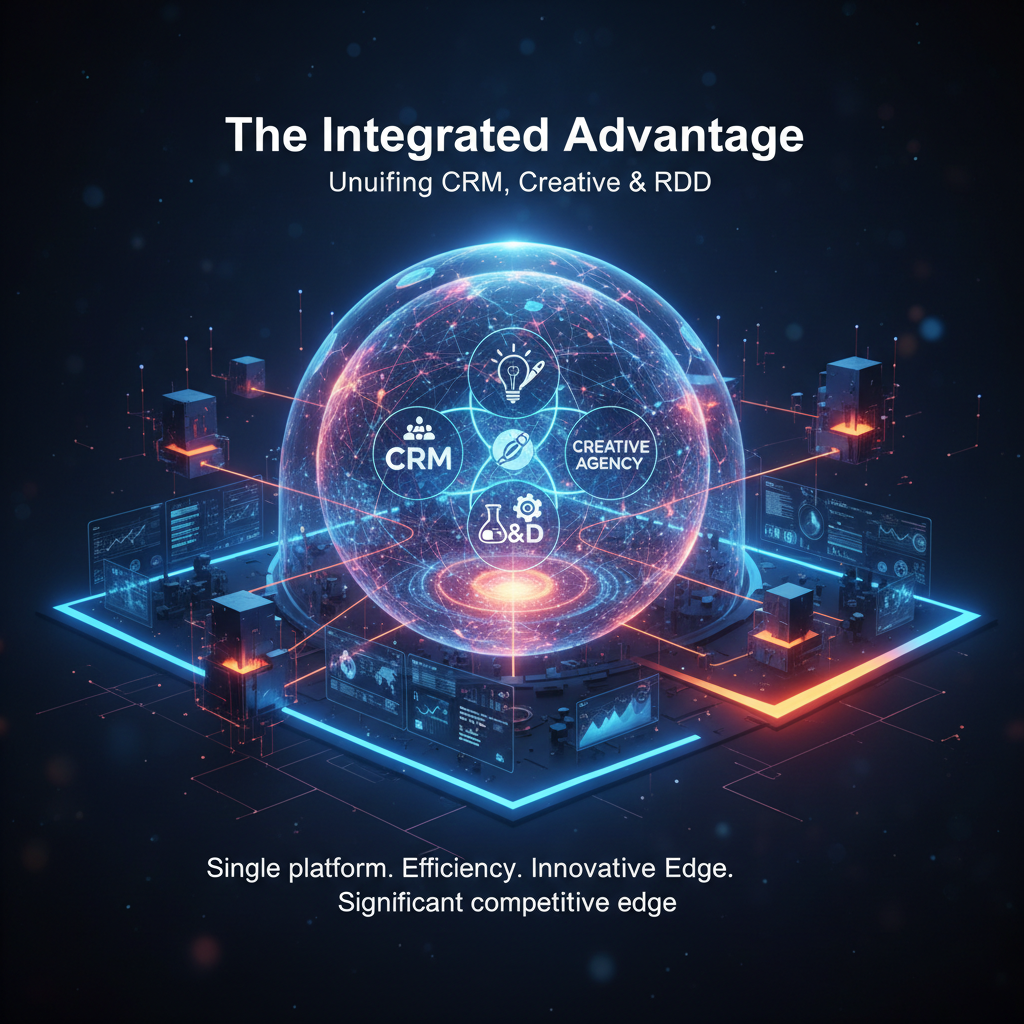
The Integrated Advantage: Unifying CRM, Creative & R&D
As a consultant who has spent over 15 years navigating the complexities of global business transformation, I've seen one silent killer of productivity more than any other: fragmentation. The modern enterprise is often a patchwork of disconnected software, siloed departments, and misaligned vendors. Your sales team lives in the CRM, your marketing agency operates in its own creative suite, and your R&D department pushes code from yet another environment. This operational friction isn't just an inconvenience; it's a strategic liability that drains resources, slows innovation, and creates a disjointed customer experience. The path to outpacing your competition lies not in adding more tools, but in achieving an integrated advantage.
- The High Cost of Silos: Fragmented systems create data disconnects, operational friction, and significant productivity losses. A study from the University of California, Irvine found it can take over 23 minutes to refocus after a single interruption, a daily reality when toggling between disconnected platforms.
- Synergy as a Force Multiplier: Integrating CRM, creative, and R&D creates a powerful feedback loop. Customer data from your CRM directly informs creative campaigns, while product usage insights from R&D shape marketing strategy, leading to hyper-relevant customer engagement.
- The Ultimate ROI is Agility: A unified operational hub enables businesses to move faster, adapt to market changes more effectively, and innovate continuously. This agility translates directly into a sustainable competitive edge and improved bottom-line performance.
Table of Contents
- The Hidden Costs of a Fragmented Operational Stack
- The Synergy Engine: How Integration Fuels Innovation
- Case Study: Transforming a Mid-Market Tech Firm
- The Strategic Framework for Successful Integration
- Overcoming the Hurdles: A Realistic Perspective
The Hidden Costs of a Fragmented Operational Stack
On the surface, using best-in-class point solutions for each business function seems logical. You get the best CRM, the best project management tool, and the best analytics software. However, the cost of this approach is hidden in the gaps between these systems. In my experience advising executive teams, these costs manifest in three critical areas:
- Data Incoherence: When your CRM data doesn't speak to your marketing automation platform, you end up with an incomplete picture of your customer. Marketing might be targeting a segment with a message that sales already knows is irrelevant based on recent conversations. This lack of a 'single source of truth' leads to wasted ad spend, poor personalization, and a frustrating customer journey. According to Gartner research, data silos are a primary obstacle to executing effective digital strategies.
- Productivity Drain: The constant need to manually transfer information, reconcile data between systems, and manage multiple vendor relationships is a significant drain on your team's most valuable resource: time. This 'context switching' erodes focus and introduces opportunities for human error. The cumulative effect across an organization can be staggering, effectively acting as a tax on every single process.
- Strategic Misalignment: The most damaging cost is strategic. When your R&D team develops features based on their roadmap without real-time insights from sales and marketing, you risk building a product nobody wants. Conversely, when your creative agency develops a brilliant campaign that isn't aligned with the product's actual capabilities or the sales team's talking points, the entire go-to-market effort is compromised. Fragmentation breeds misalignment, and misalignment stifles growth.
The Synergy Engine: How Integration Fuels Innovation
Breaking down these silos transforms them from disparate cost centers into a cohesive, value-creating engine. The integrated advantage is realized when these core functions—CRM, creative, and R&D—operate in a continuous, symbiotic loop. This is not just a technical integration; it's a fundamental shift in operational philosophy.
CRM Data as Creative Fuel
Imagine your creative agency having direct, real-time access to customer behavior data from your CRM. They can see which customer segments are most profitable, what pain points are most frequently mentioned in sales notes, and which support tickets are trending. This intelligence allows them to move beyond generic, persona-based marketing to create hyper-personalized campaigns that speak directly to the customer's immediate needs and context. The result is higher engagement, better conversion rates, and a feeling that your brand truly understands its audience.
R&D Insights Driving Marketing Strategy
Simultaneously, data from your product development and R&D teams becomes a goldmine for marketing. Are users adopting a new feature? Where are they getting stuck? This usage data, when fed back to the marketing team, allows them to create targeted educational content, highlight popular features in campaigns, and proactively address areas of confusion. After implementing this for a B2B SaaS client, we found that marketing campaigns focused on feature adoption, driven by R&D data, had a 35% higher engagement rate than their standard top-of-funnel content.
A Closed-Loop Feedback System
The true power of this model is the closed loop. Here's how it works:
- Market Insight (CRM): Sales and support log customer feedback, needs, and market trends in the CRM.
- Informed Development (R&D): The R&D team uses this data to prioritize its development backlog, ensuring they are building features the market is demanding.
- Targeted Messaging (Creative): As features are developed, the creative team builds go-to-market campaigns using the original customer insights from the CRM to craft resonant messaging.
- Campaign Execution & Measurement: The campaign is launched, and its performance data is captured and fed back into the CRM, enriching the customer profile.
- Iterate: The cycle repeats, getting smarter and more efficient with each revolution.
Is Your Operational Stack Holding You Back?
Fragmented systems create invisible friction that costs you time and opportunity. A unified platform is the key to unlocking exponential growth. Let's explore how the Development Hubs at SolutionsChapter.com can streamline your operations.
Schedule a No-Obligation Strategic Consultation
Case Study: Transforming a Mid-Market Tech Firm
To illustrate the tangible impact of an integrated approach, consider the case of a mid-market SaaS provider I worked with. They were facing slowing growth, and a diagnosis revealed classic operational fragmentation.
- The Problem: Their sales team used Salesforce, their marketing was outsourced to a creative agency using a separate suite of tools, and their product team worked in Jira. Communication was manual and sporadic. Campaign launch cycles often took 8-10 weeks, and the marketing messaging felt disconnected from the product's evolution. Customer churn was beginning to tick upward.
- The Solution: We implemented a unified operational model through our Development Hub. This involved consolidating their core functions into a single ecosystem. The Studio provided integrated digital marketing and web development, directly linked to their CRM data. The Business Lab was engaged to build a predictive analytics model that used sales and product usage data to identify at-risk accounts.
- The Timeline: The initial integration and process re-engineering took six months. This was a significant change management effort, requiring buy-in from all department heads.
- Measurable Results: The outcomes, tracked over the following 12 months, were transformative:
- Client Testimonial: "Before working with Abbas, we were three different companies operating under one name. By unifying our CRM, marketing, and product teams on a single platform, we stopped pointing fingers and started solving problems together. The integrated advantage is real, and it's reflected directly in our bottom line." - CEO, Mid-Market SaaS Firm.
The Strategic Framework for Successful Integration
Achieving this integrated advantage requires more than just buying new software; it demands a strategic, disciplined approach. Based on dozens of successful transformations, I've refined a four-step framework:
- Conduct a Full Operational Audit: Begin by mapping every workflow that crosses departmental lines. Identify the tools used, the data sources, and, most importantly, the points of friction. Where are the manual handoffs? Where does data get lost or misinterpreted? This provides your baseline.
- Define the 'Single Source of Truth': For most organizations, the CRM should be the heart of the ecosystem. It holds the most valuable asset: customer data. All other systems—creative, R&D, finance—should be designed to both pull from and push back to this central repository.
- Execute a Phased Integration: Don't attempt a 'big bang' changeover. Start with the highest-impact integration point, such as connecting your marketing automation to your CRM. Secure a win, demonstrate value, and then move to the next phase. As Harvard Business Review notes, successful strategy execution is about momentum and incremental progress.
- Establish Cross-Functional Governance: Create a standing committee with leaders from sales, marketing, and product. Their mandate is to own the integrated system, resolve conflicts, and continuously look for opportunities to optimize the process. This ensures the integration remains a strategic asset, not just a technical setup.
Overcoming the Hurdles: A Realistic Perspective
While the benefits are immense, it's crucial to acknowledge the challenges. A transition to a unified model is a significant undertaking. In my experience, the primary hurdles are not technical but human.
- Cultural Resistance: Departments are accustomed to their tools and workflows. The idea of ceding control or changing processes can be met with resistance. Overcoming this requires strong executive sponsorship and a clear articulation of the 'What's in it for me?' for every team member.
- Technical Debt: Legacy systems can make integration complex and costly. A thorough audit is essential to understand the true scope of the technical lift required. Sometimes, a full replacement is more cost-effective than trying to patch an outdated system.
- Upfront Investment: There is an undeniable upfront investment in both capital and time. However, it's critical to frame this not as a cost but as an investment in operational scalability. A Forrester Total Economic Impact™ study on unified platforms often reveals a payback period of less than a year, with a multi-year ROI exceeding 200-300% due to increased efficiency and revenue.
Ready to Build Your Integrated Advantage?
Innovation shouldn't be a struggle. Our Development Hubs provide the unified SaaS tools and expert guidance to align your CRM, creative, and R&D into a single, high-performance engine.
Explore the SolutionsChapter Development Hubs
Conclusion: Your Next Competitive Edge
In an increasingly competitive global market, the companies that win are those that can move with speed, intelligence, and cohesion. The era of siloed operations is over. The integrated advantage gained by unifying your CRM, creative agency, and R&D under one roof is no longer a luxury—it is the new benchmark for high-performance organizations.
By creating a seamless flow of information from customer insight to product development to market messaging, you build a resilient, agile organization capable of not just reacting to the market, but shaping it. The fragmentation in your current stack is a tax on your growth. Eliminating it is the single most powerful lever you can pull to accelerate innovation and secure a lasting competitive edge.
If you are ready to move beyond the limitations of a fragmented operational model, the first step is a strategic conversation. Let's discuss how a unified approach can unlock your organization's full potential.
Comments & Feedback
No comments yet. Be the first to share your thoughts!